

4G vs 5G: what changes for your network
4G and 5G are terms that we hear every single day from people from all age groups. Be it little kids who are hooked on to mobile phones to watch their favorite cartoons, to individuals from the industry who are rigorously waiting for 5G to come. A buzzword that has been doing its rounds across
Short answer: 5G differs from 4G in four main ways: connection speed, latency, coverage and bandwidth. 5G is designed to be much faster than 4G, with lower latency and a far wider spectrum, while 4G still has the broader footprint in many areas. For business sites, the two work best together, with 5G used where it is available and 4G as the fallback.
4G and 5G are terms that we hear every single day from people from all age groups. Be it little kids who are hooked on to mobile phones to watch their favorite cartoons, to individuals from the industry who are now putting 5G to work. After years as a buzzword, 5G has launched in India.
With evolution, it’s a no-brainer that connectivity and networking have drastically evolved and made their impact on individuals, enterprises, and the economy. Starting from years ago, where 1G meant the ability to make calls to where we are today, 4G brought intelligence to our lives. With every “G”, communication is greatly being modified and enhanced. That being said, there is a lot riding on 5G (no pressure).
But all that being said and done, many people are still unsure what exactly 5G offers that 4G does not.
Let’s deep dive into what 5G brings that 4G does not.
Is 5G faster than 4G?
Yet another no-brainer: 5G brings higher connection speeds. It is designed to be much faster than 4G, though the speed a user actually gets depends on the network and the location.
How does 5G latency compare with 4G?
Latency or the amount of time it takes for a packet of information to travel. 5G aims to have a significantly reduced latency, along with having a more optimized and well adjusted level of network architecture.
Does 5G have wider coverage than 4G?
Today, 4G is present in predominantly every major city across countries. But there are still remote locations which do not get proper connectivity. 5G coverage is still growing in many areas, and it aims to offer wider coverage over time.
Does 5G offer more bandwidth than 4G?
5G uses a much wider spectrum of bandwidth than 4G, which leaves more room for traffic and, in turn, provides more speed and frequency range.
There are more reasons why 5G is more efficient than 4G, and with 5G now live in India, businesses can use it alongside 4G at their sites.
Related: 5G wireless SD-WAN for branch sites, Instaroute 4G and 5G routers and industrial 4G router buying guide.
Frequently asked questions
What is the main difference between 4G and 5G?
5G is designed for much higher speeds, lower latency and wider bandwidth than 4G. 4G remains widely available, while 5G coverage is still growing in many areas.
Is 5G latency lower than 4G?
Yes. Lower latency, the time a packet takes to travel across the network, is one of the main design goals of 5G, along with a more optimised network architecture.
Can one business router use both 4G and 5G?
Yes. Nexapp's Instaroute Enterprise X Series includes 5G models such as the IRX100-5G with 5G SA/NSA support, and Instaroute routers offer dual-SIM arbitration so a site can use more than one mobile link.
Should a branch office choose 4G or 5G?
Where 5G coverage is good, it gives more capacity and lower latency; where it is not, 4G LTE is the practical choice. With SD-WAN, a site can run both links and steer traffic to whichever is healthier.
To find out how Nexapp uses 4G and 5G for business sites, see 5G wireless SD-WAN from Nexapp.
Related guides
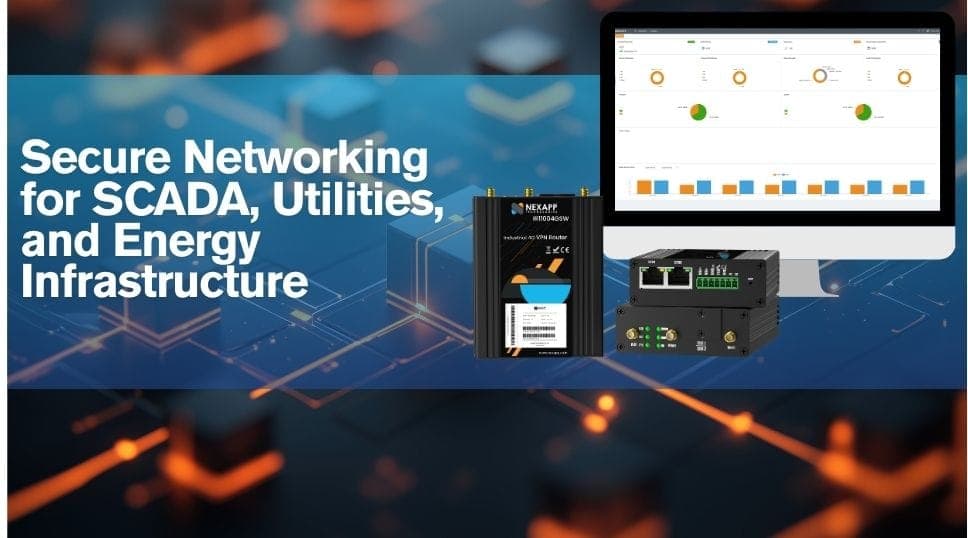
Secure SCADA Networking with a 4G/5G IoT Gateway | Nexapp
How an industrial 4G/5G IoT gateway secures SCADA and utility sites: IPsec tunnels, IEC 104, DNP3 and Modbus, OT/IT segmentation and DIN-rail design.
Instaroute SD-WAN Router: 6 Key Features | Nexapp
Nexapp Instaroute SD-WAN router features: dynamic path selection, QoS, application-aware routing with DPI, failover, central control and encryption.

How SD-WAN Supports Digital Transformation | Nexapp
SD-WAN supports digital transformation with central control, application-aware routing, built-in security and faster new-site rollout across MPLS and LTE.
Talk to a Nexapp architect about 4G vs 5G: Key Differences in Speed and Latency | Nexapp
24×7 NOC in Pune · 75,000+ devices deployed · 400+ enterprise and banking customers since 2014.